Monday, November 21, 2011

Soup's On!

Forgive me, dear readers, for my absence.  The blog has suffered from “way the heck too much other stuff going on” syndrome. Also, less time in the garden after final harvests has given me room to move in other directions. But now, I’ve been called back by the influx of cold air which has jump-started another seasonal love of mine: fall cooking.
I live in a house that could be sufficiently heated by the oven.  Because of this, the modern day hearth doesn’t get much use in the summer.  Once cold weather hits, I’m reminded of this seasonal toy and look forward to one of my favorite past-times – baking bread.  But your title is about soup, you say.  Yea, I know…I’ll get to that.
I grew up in a home where things that can be lovingly made by hand were purchased instead.  My mother was at an impressionable age during World War II when her country, Ireland, tightened their belts, rationed their goods, and got out their knitting needles to help their English neighbors whom they were rooting for in the war.  In school, they made socks, hats, gloves, and sweaters for the English soldiers.  To hear my mom tell about it, you’d think she’d been forced to make all those things every day for the duration of her childhood and beyond.  She’d moan with exhaustion at the mere mention of my wanting her to teach me how to make a sweater.  “Just go buy one!” she’d say.  Ah,… industry.
And yea, I know.  I’m getting to the soup…
For me, the thought of making something from two sticks and a ball of yarn seemed like magic.  But the first time I got to bake bread in Brownie Scouts (where I learned to knit), something even bigger lit up inside me.  Most likely it was the aroma that put bread ahead of knitting in my awed esteem.  I ran in the house after the bread baking meeting yelling, “Mommy, mommy!  Let’s bake BREAD!”
She groaned. 
“It’s hard, hard work,” was all she could manage to say.
I had just done it, like an hour before, and I guess since Brownie leaders were probably the first to discover “kid friendly” projects, it hadn’t felt like work at all.  Somehow I convinced her, and we set out to bake a loaf the following Saturday, starting in the morning, because, you know, this would take ALL day.

I started my kids at it much younger.  I needed something for them to do as an alternative to their ususal daily activity of bruising their faces which, believe me, was getting OLD....

I won’t bore you with the slightly comedic details.  Suffice it to say that at age 7 I had experienced the first and last bread baking extravaganza in my home of origin.  In addition, the lingering memory of the effort involved was spoken of well into my adult years, without any mention of the delicious bread we made.  A Buddhist would suggest my mother actually slaved over the dough thousands of times with all her mournful recollections.  I, on the other hand, just remembered the good part.
So, when I was on my own, I started experimenting with different kinds of bread.  Believe me, coming home from college with a loaf of something unique and tasty impressed my mother to the point that she forgot about yelling at me about my grades.  Clearly, I was achieving great things, and she didn’t have to suffer through watching the painful process.
And bread led to soup, because besides butter, what else goes so well with fresh baked bread than real soup?  Oh, and canned doesn’t count.  The acidic aftertaste is the great equalizer of any store-bought variety, and really, I’d just rather not.  It’s not because I’m a foodie snob.  It’s because fresh homemade soup is on the same wavelength as fresh homemade bread and to break the spell on one just screws up the other.

Split-Pea!  Yum!
Plus, soup is easy.   Just give Stone Soup another read and you’ll know what I mean.  For me, to grab a few things from the garden, including wild greens, a carrot I missed earlier, or the potatoes that dodged the fork just adds to it; a blending of flavors where repetition is a rarity.  Mmmm…., time to savor the best the good earth has to offer.

Tuesday, October 18, 2011

Mo Power to Ya

Space time continuum?  Time space continuum?  Which is it?
I wonder as I’ve just spoken to a friend who reports his infant baby girl is feeding, eyes wide, arms outstretched, with her mama in the NICU.
Time depends on what you’re doing.  As life emerges and unfolds, time is completely relative.  Widening eyes on a tenacious new life, punctuated by an eager acceptance of love and nourishment, take us to a place where a clock means absolutely nothing.  A new kind of time supersedes what we’ve known, and space opens up for us to explore these feelings that have never stirred us before.
It’s like falling in love.
It’s power.
(The good kind).

Sunday, October 2, 2011

Seed Savor


For those of you who want to extend the delights of your summer for time to come, may I suggest seed saving.  I’m sure there are scientific procedures that will ensure optimal viability, but for now, I’m just writing about what I know.  I’m sure there will be plenty of opportunities in my future to study this further, at which point, I’ll keep you informed.

But for now:  Seed Saving 101 with the Garden Miner

Arugula gone to seed.  Check out the pods on these long stalks that recently displayed  beautiful white flowers. (Strawberries nearby...if you've never tried it, a salad pairing arugula with strawberries is quite delicious.

Step 1:  Know what to look for.  When your leafy green plants, such as spinach, cilantro, arugula, lettuce, kale, etc., start to flower, enjoy their blooms and wait for the seeds to present themselves.  I usually wait until things look dry and ready to drop.  And, if you think about it, isn't that how the plant would naturally perpetuate itself?  Dried out and withered, all it would take would be a nice gust of wind to scatter the seed.  The protective pod (below) would assure shelter for the months to come, finally softening and swelling with rain and warmer soil, thus easing the protective layer open, allowing the seeds to emerge.

Which brings us here...I did natures work so that I can put the seed where I want.
 Step 2:  Collect.  In the above picture, I've gently cracked open the pod to find the arugula seeds. The two pieces of pod are separated by the finest film membrane. Nature is so well designed!


Or if you're dealing with seed inside the fruit....
 In the above picture, I am pulling seed from the fruit.  These little tomatoes are packed with seed, and selecting just a few really good fruits will assure me summers of plantings to come.  I was surprised the first time I saw this technique.  Out here in the country, we have what we call "old-timers."  They're people who grew up around here, and who know how to do things well without having to use every available gadget known to mankind.  The man who gave me some Ox Heart Tomato seed (what he called "Aunt Claire's" due to his aunt's amazing skill at growing them) was the first to show me this trick.  I remember asking, "That's all?!"   To which he replied, "Well, ya gotta label it!"

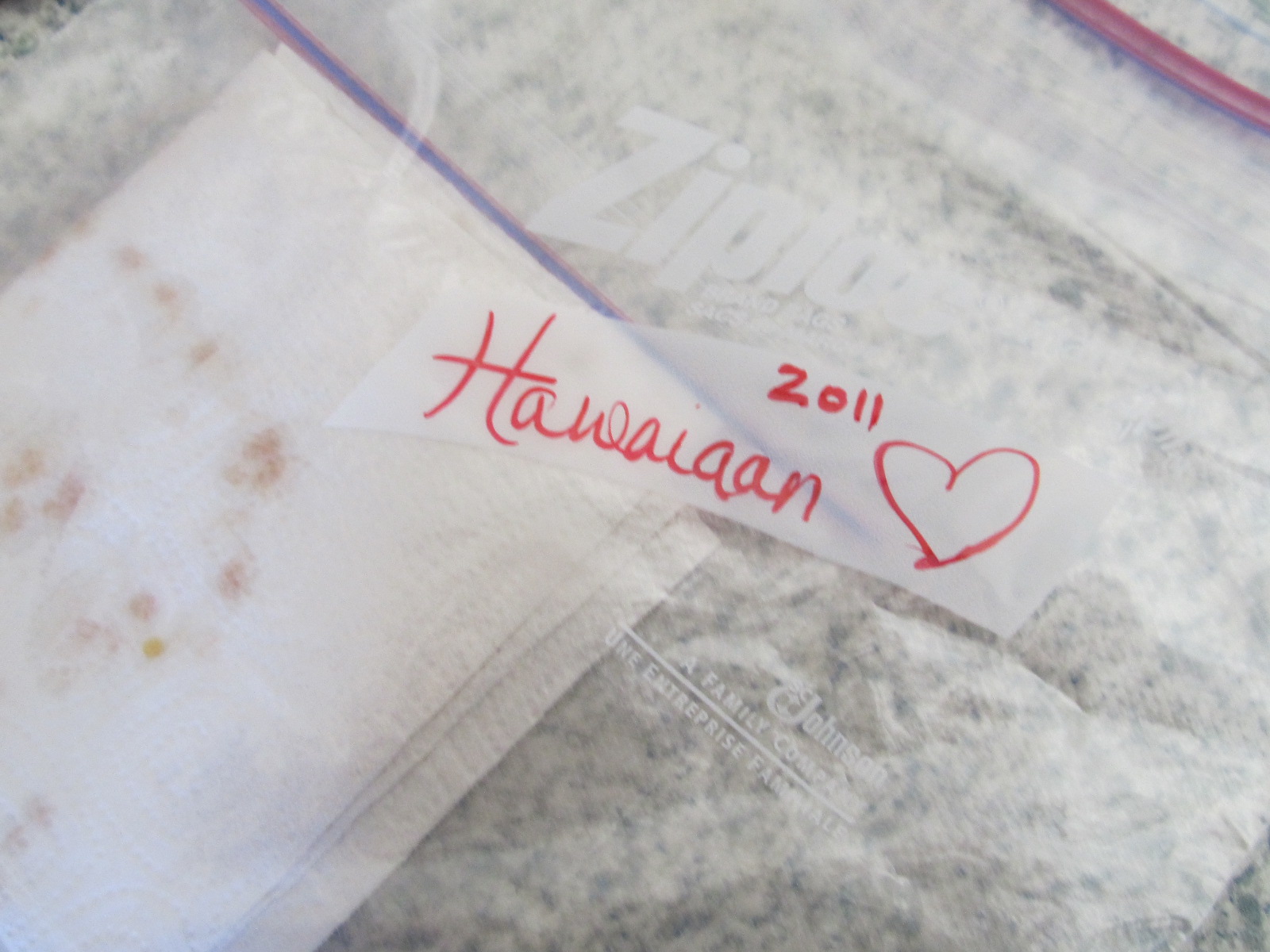
A few years later, I received in the mail seed similarly stored from a friend in Washington state who introduced me to these above pictured sweet-as-candy tomatoes (I call them "Little Hawaiians" since they originally came from there...not sure of their real name).  It was very cool to see that even more people in the know were perpetuating species with such a simple technique.  Cooler, still, was that upon opening the package I knew exactly what kind of seeds they were.


Which takes us here...label your seed.  This is packed, ready to be stored in the freezer
Step 3:  Label.  Believe me, I store so many things that I'm sure I'll remember, and then don't.  I tend to plant things as well, knowing the logic (or lack thereof) of my placement will stick with me until the plants emerge.  Um...no.  That doesn't actually work, and for some strange reason, I'm still not convinced.  But, when it comes to seeds, I do manage to label them.  Maybe it's because I know if I store five different types of tomato seed, I might forget which is which.  When I actually plant them, I know they'll show me who they are, and labeling my patch never gets done.  But, for seeds:  label, add the date, and stick in the freezer.


or...place in a paper bag and stick in an airtight cooler.  Seed separated from pod.  Pod a nice treat for the chickens.

Finally, after you've saved seed you can envision your plans for next year.  I sometimes think about a new way to grow something, and then use my saved seed, knowing they came from the same crop. I'll test my proposed theory with both an experimental and a control patch.  Over the years, as well, you'll get to know your plants better since you've maintained a line.  Whatever your goal, the best part of all of this is the added understanding you'll have about growing your own food.  Most definitely, that's something satisfying to savor.