Showing posts with label newspaper. Show all posts

Friday, May 20, 2011

No-tato Bugs

This garden miner has Irish roots.  In fact, my mother is full blooded, 100% Irish.  My father was 50%, but in his heart, more like 98%, holding out just a bit for his hasenpfeffer and Wiener schnitzel which he enjoyed a few times a year at his favorite German restaurants.  At home, though, Irish cooking was the norm.  And yes, we had some potatoes.
So when I can grow potatoes, life is good in the garden.  I enjoy feeling close to my roots both figuratively and literally.  And closeness is what the plant needs; it wants you to pay attention.
Central Virginia is doing the Irish thing right now.  We’ve had enough rain and gray skies to help the potato plants stand tall as they shout Erin go Bragh!  And that clamor has called forth some very hungry and prolific potato beetles.  They can wipe out your crop, so if you too are in need, let me help you identify them and show you what to do to keep your plants healthy:

REM would be so proud
 I was going to start with the dreaded beetle, but thought better of that.  Here are some of my plants.  I planted a truckload, it seems, as this is just one small selection of my Pontiac Reds.  You can see they're flowering, which means baby reds, aka "new potatoes" like the little ones you get at the market, are ready for picking.  I grow potatoes in straw:  At planting time I dig a small trench, lay potatoes down about a foot apart, cover with soil and then add a few inches of straw (not hay - you don't want grass seed).  As the greens emerge, keep buttressing the plant with straw.  I will actually be adding more this weekend, so you can go higher than I have here.  Straw has two benefits:  1) it keeps the potatoes in a looser medium which makes harvesting throughout the season easier and 2) the potato beetles have a harder time getting to their luxury destination (the leaves). The walkway is newspaper covered with a thin layer of straw to keep down the weeds, but my Zen Master, (bermuda grass) has crept in, D'oh!
Not the Mr. Stripey I want to see in
the garden


Here he is.  Ugh.  Cool looking, for sure, but you don't want him around.  So what to do when you see this?  Crush him between your fingers (wear gloves cuz the yellow ooze is just gross) or just pop him into a cup of soapy water.  BTW, soapy water is my method of choice for Japanese Beetles. 
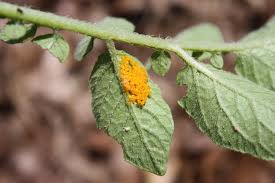

Then check the underside of your leaves for the yellow eggs and crush them.  Just smear them right up.  I have recently discovered that as the larvae hatch, they eat their way through to the upper side of the leaf from the spot in which they were born.  Nature is so fascinating when you can put your aggravation at what's happening to your plant aside for a moment.

So you missed some eggs, and you will.  Not to worry, yet.  You can see in my first picture that some of my leaves have holes.  That's because these guys made it through my defense. This is why you need to check your plants regularly.  You're bound to hit the cycle somewhere.  These are quite crushable as well, so have at it.  They disperse quickly, so if you see one, keep looking over the plant and at the neighboring potato plants.  Once while visiting Monticello, I was stunned to see millions of these things on the potato plants in the garden.  A woman passed by and said, "Now that's a different kind of ladybug!"  I said, "Those aren't ladybugs, that's negligence."  On the way home I don't know who was more upset:  Me about the bugs or my youngest upon learning that Thomas Jefferson owned slaves.  It was a long, somber trip home. 
BREAKING NEWS!  Assassin caught
snacking between meals!

Had there been ladybugs on the plants, all would be well.  They're a great benficial to eat the eggs, and my friend the assassin (he's a beetle) goes after the larvae.  So that's another thing to check...who else is hanging around?  If you see parasitic wasps, ladybugs, assassin beetles, and/or spiders, congratulations!  You have just won the prize for providing what your garden needs to attract beneficials.  They're the hired help whose remuneration is good eats that you're happy to share.  Doesn't the assassin look like he got caught in the act on some convenience store camera?  I may have to send this to "Inside Edition."


Buckwheat - so easy to plant, just broadcast seed
EVERYWHERE.  You'll be glad you did.

Lastly, how do you attract beneficials and provide other deterrents?  Plant buckwheat and clover (red or white) near your plants to attract the bugs you want. Nasturtium (which comes from the Latin meaning "to turn the nose") repels potato beetles, as do dill and cilantro, which also happen to taste really good with potatoes - a nice added benefit.  Eggplant is a good trap crop, but the two I planted did such a good job there's nothing left of them, so I'm moving on to a new plan.

 So pay attention, and enjoy!  As you check your plants, take a peek and see if you have some new potatoes coming in.  Who knows? You might just get a few nuggets to enjoy for your time and effort.

Sunday, May 15, 2011

Soil Prep 101

I dig digging.  Getting out there and feeling the shovel slide right through the earth with my foot enforcing just the right amount of pressure is soooooo satisfying.  However, there is a deterrent to a good dig that I face on a regular basis.  That, my friend, is grass.

Nothing blocks a smooth sink more than grass roots.  "ARRRGGGHHHHHH!" is all I can say.  When I'm patient, I do the circular perimeter (aka the circumference) approach where I create a disk broader than the god forsaken clump, then slice it off underroot and feed it to my pigs (after freeing the worms).   But there are other times where I just can't face it and go to plan b.  In case you didn't know it already, I'm the self-proclaimed Queen of Plan B.  It makes life interesting and reminds me that yes, there are options.

So here's an option I just love:  lasagna gardening.  This is where grass (and all its neighbors) get smothered to the point of compliance.  All you need is some newspaper, compost, anything green (that actually grew from the ground at one time), and black plastic.  Oh, and time.  What you see below is from soil prep that began in the fall, uncovered last week; lasagna baking for about 7 months, mmmm!

So I'll walk you through the process with a few pics from a recent soil extravaganza..... And here's a secret - put the lasagna ingredients down in any order you choose.  It's like cooking - do what works for you.  I typically put down layers according to what I can do at the time.  And if you don't have everything -- no biggie.  The most important component is newspaper, an earthworm magnet (I use paper printed with soy ink, thanks Mom for saving all those papers for me!) If you don't have newspaper, go with cardboard.  Just make sure it's not lined with plastic because after decomposition, you're left with flimsy plastic bits that are difficult to extract and aren't good for worms or the soil. 
Here you see a large piece of black plastic under which is a layer of all the things mentioned above.  The plastic lets things cook.  I know it's unsightly, but, I don't care because what it gives me is beautiful to behold.  Take my advice and get the heavy duty plastic.  It's durable so you can use it year after year.


Ahhhhh.....that was grass!  Notice the moisture present and the debris that can be worked in to create a nice texture to the clay-heavy soil. 

Check out the holes in the soil, courtesy of worms, ants, and pill bugs, some of the world's greatest aerators.
If you look carefully, you can see this worm hasn'tquite finished with this paper yet....
A sign of good soil prep.  Lots of worms who are happy to stick around for as long as you like.  Time to plant!

Saturday, April 9, 2011

Path Analysis

Currently, in my Stats V class we are looking at paths and understanding (or pretending to) how latent factors influence outcomes.  In other words, if a kid is unhappy, how does that affect school academic performance?  Can we see unhappiness?  No.  We can see manifestations of unhappiness, but not an actual emotion, thus the term latent (hidden).  Path analysis looks something like this:


Please don't go.  I promise not to frighten you any longer.

I've been conducting my own path analysis in the garden over that last few days.  Each year I put down newspaper to mark my paths and cover with pine needles, leaves, or straw.  Working in a light rain is heavenly, as long as there's not too much wind blowing about, which qualifies as hellish.  The purpose, is quite obviously, to delineate where feet do and do not go so that soil enjoys being loose and not compacted to the point where it can't breath.  As overgrown as I sometimes let things go, or more importantly, as chaotic as I let companions get, paths are sometimes only clear to me, the gardener.

Setting a path is making a statement.  In life, they say each journey begins with a single step.  Behind that step, however, is the power of intention, and that's what struck me today.  Sometimes my plants choose where they want to be.  Typically, that's the way it goes with my wild inhabitants and volunteers.  Other times, I may decide on a location for seedlings, but when I get to digging, I realize the soil isn't optimal for that particular plant, and we go looking together for a better home.  Occasionally, I know precisely where I want to lay a crop, and make it happen.  Each bed has a purpose, and when I say the word "garden" I'm sure people typically picture a variety of plants.

But the paths are just as important.  They allow me to get to where I need to go and open my view.  And in the garden, paths offer clearer options.  The mysteries and secrets still thrive in the microcosms of the garden beds, which is where the real joy of gardening resides.  The paths encourage me to meander through to find them, which I intend to do.

Sheep making their own path beyond the garden.